Posts

Showing posts with the label squash vine borers

Eastern Cottontail rabbit habitat
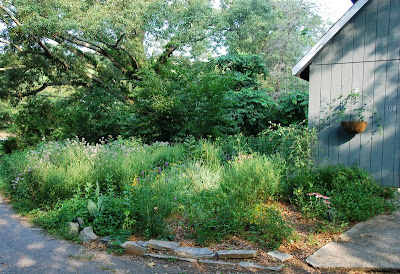
Image
In our garden, currently, 'our' rabbit hangs out here. the 'front meadow' aka the Piedmont prairie But all of the young okra seedlings, and a number of squash leaves in the satellite garden disappeared yesterday evening, so I don't know whether to think 'rabbit' or 'young woodchuck.' Oh, well, we don't much care for okra (it was an experiment) and unless the squash vine borers hurry up (there have been a few casualties already), we'll have more squash than we can eat. We're fortunate (and I'm grateful) to have plenty of space to spread out herbivore impact. Probably the mama woodchuck will come up from the woodpile and eat all of the squash vines while we're up in the mountains this weekend and I won't sound so positive!

Giant squash and other oddities

Young small squash are absolutely delicious, and not shippable at all. From home gardens and farmer's markets, they're a summer highlight. I like to enjoy as many different summer squash as I can, and for some reason, am hopeful this season to avoid the dreaded squash vine borers that allow me to harvest one or two from my vines, before causing collapse of the entire plant. Who knows why I think my pattypan, flying saucer, eight ball (Ronde di Nice), cocozelle, butterstick, etc. C. pepo squashes might avoid them this year? Extra cold weather this winter? Late planting? Unusual optimism? We'll see. I'm sure my reliable tromboncino squash (a C. moschata variety) and perhaps the mystery summer squash mix (AKA small young gourds) will provide nice fruits regardless (uh, unless the woodchuck(s) are extra hungry). But I always pick my squash when they're young and tender, knowing that that's when they're the best. But I was a bit dismayed to see giant patty...

Squash bees and flowers

Image
Squash flowers are abundant on the long rambling vines of two of the Cucurbita moschata types that I'm growing. Normally, C. moschata are winter squashes (butternut, etc.), but I've enjoyed growing the varieties that are eaten fresh -- Tromboncino for several years and this year, I added something called 'Summer Mix' which is a yellow-fruited C. moschata type. Both are tasty, and resistant to both squash vine borers and squash bugs. Squash bees actively gather pollen and nectar from dawn through mid-morning, emerging from their ground nests to forage in the squash patch. Their biology is fascinating, but that's another post -- I need to go transplant basil seedlings before it (hopefully) rains! Squash vine borer damage -- ugh -- it's tough to organically manage. Careful rotations and deep cultivation that disrupt the moth-egg-larvae life cycle seem like the main defense. Bt injections, wrapping the vines with foil or plastic (ugly), row covers (then you ...