Posts

Showing posts with the label lettuce

Year-round vegetable gardening

Image
In the Southeastern U.S, we have ample sunshine (over 10 hours a day, except for about a week and half around the winter solstice) for growing vegetables year-round.  In 'normal' winters, we can grow kale and collards that sail through normal freezes, as well as garlic and onions. In exceptionally cold winters (like the last couple of years), unprotected hardy greens have suffered significant frost damage.  But even this year, mustards have re-emerged looking pretty leafy in protected walled gardens like the kitchen garden next to the visitor center at the Garden where I work. I've been delighted with my winter greens experiment in the unheated hoophouse at the Garden --totally amazing.  I'm planning to sow a short season sequence of greens in the pots and bags of soil mix, as well as chard and beets, just to see what happens.

Growing swiss chard

Image
I haven't had much success with Swiss Chard in the past, in spite of it being an 'easy' vegetable. My fertilizer challenges (uh, I studied native plants, not nutrient-hungry vegetables) are evident in this regard, but I'm trying to mend my ways. Compost, aged manure, mushroom compost, etc. as soil amendments aren't enough to maintain fertility, in continually cropped beds (eg. my main and satellite vegetable garden areas at home in the Piedmont- in the Southeastern US). So I've been mindful of the benefits of adding organic timed-release fertilizer (Espoma is one brand that provides a nice range of major and micro nutrients). My new raised beds, in the mountains, though, have been (so far) quite supportive of leafy greens, being filled with compost and composted manure. I've been delighted with the lush lettuce, radishes, arugula, and swiss chard that have been part of the early plantings, and have been in harvest mode recently. This swiss chard is the nic...

Lettuce abundance

Image
My raised beds in the mountains are producing prolific lettuce; undoubtedly the rich soil and cooler temperatures are favorable to excellent leaf growth. I've had nice mesclun mix in flats for many years, and good lettuce in my main vegetable garden in the Piedmont, but these lettuces reflect how lots of nutrients (from the compost in the beds) and plenty of water produce succulent leaves. Yum.

Looking forward to fresh vegetables

Image
If I'd put up simple hoop houses last fall, maybe I'd have more to harvest after all the exceptionally cold weather. Or maybe not. My flats of greens (in the open) look fine, and have sailed through quite a bit of pummeling, but they don't look robust or large enough to harvest, as of yet. Vegetables in a Vietnamese market Even in the sheltered kitchen garden (near my office, at the botanical garden where I work), to be honest, the cold and damp (sometimes icy) weather doesn't much encourage me to go out and cut bunches of kale, argula, cilantro, or poke around for turnips, even though they look quite decent, when I've ventured forth. It's another reason to be grateful for farmers and farm workers, who make it possible for folks like me to buy a lovely large head of romaine lettuce (grown in a mild coastal valley in California) this time of year. I like to buy lettuce grown by Tanimura and Antle , a company that represents 3 generations of vegetable growers...

Planting a fall garden

My e-newsletters have been touting planting a 'second' garden lately ( Renee's Garden , Vegetable Gardener (Fine Gardening/Tauton Press), and the Tasteful Garden (a family-owned nursery in Alabama). I loved this piece (also on Vegetable Gardener) from Kitchen Gardens magazine archives on cold frames by Elliot Coleman. Geez, thanks to Elliot Coleman, I'm promoting growing vegetables year-round here in South Carolina. At least three seasons! One of the nicest things about the Vegetable Gardener e-newsletter is that they're providing archival material from KitchenGardener magazine . I had subscribed, years ago, just before it stopped publication, and there is great information to be gleaned from their archives. Happily, growing vegetables is a subject that doesn't change a great deal; we add new vegetables, extend the seasons, and grow organic, but it's still about improving the soil, plant nutrients, and water. I was delighted to have a nice group in...

Garlic, spinach, mustard greens, and lettuce

Image
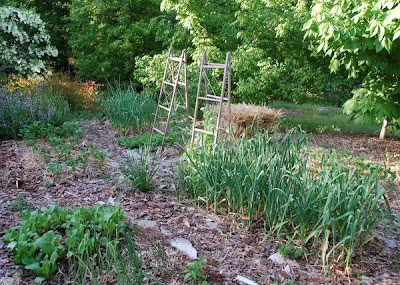
Garlic, radish, potatoes, snap peas, and a couple of hay bales ready to plant Abundant rain this winter and spring (hooray!), along with some very warm days over the last week, has the vegetable garden growing rapidly. I might actually be able to try cooking some fresh favas (broad beans) this year. There are a few pods on the small number of plants that overwintered. These plants came from seed sown in early February --it'll be interesting to see if they're able to set any fruits before our hot weather sets in. Fall planting followed by overwintering is usually the best method in our climate, but this year's cold winter zapped that! Right now, there are more greens than we can eat directly -- the mustards, Asian greens, and older salad mix will become stir-fries; younger lettuces, spinach, purple mustard, arugula, and green onions, we'll eat fresh. The garlic and onions are looking very promising, and the potato foliage looks great. I'll be planting squash and...

Spinach and lettuce seedlings

I'm not sure if they'll make it through the deep freeze after our big snow, but I was glad to see spinach and salad mix seedlings in my large containers this afternoon. I hadn't looked at them in a couple of days because of the snow, and the fallen power pole to the house that had come down and was lying on top of my potting bench, next to these pots. But, with power turned off, and trying to get the pole and meter fixed again, I noticed an abundance of seedlings popping up, covered with small patches of unmelted snow. I'd figured my early unsheltered sowings were food for the blue jays at this point, so I was delighted to see them.

Spinach, lettuce, mustard, and mache

Image
In the main vegetable garden this winter and spring, I'm avoiding planting brassicas (kale, collards, arugula, mustards, etc.) to dampen the root-knot nematodes (even though I have a few overwintered collards). I'm also only going to plant nematode-resistant tomatoes and peppers when warm weather comes. So, garlic, onion sets, lettuce, mache, and spinach are what I've planted so far. The garlic went in last fall, with the onion sets being stuck over the last couple of weeks, and the greens just sown. I also sowed a couple of flats of spicy mesclun and radicchio, as well as large containers of spinach and mesclun. These can all be protected if a hard frost threatens. It's been mild for the last few days; not as warm as last week, but pleasant in the afternoons. I've got all the beds ready to sow greens and early cole crops in the satellite garden, and hope I'll be able to snag the woodchuck who will be undoubtedly hungry as s/he emerges on warm days! And my se...

Italian lettuce

Winter is not the time to experience the best of Italian vegetables, certainly. I've seen purple artichokes in the fields ready to harvest, as well as in markets. But there haven't been any offered up in the menus of the restaurants we've been at, alas. But, I've been fascinated by the sizeable areas of lettuces growing under hoop house covers, acres and acres of them; they're butter lettuces (the green ones) and lovely purple ones, maybe a romaine, in alternating blocks. We've been driving by these farmed areas, without a chance to stop and peer closely at them. Along the coast from Naples north to Rome, above the historic coastal town of Sperlonga (lovely, but no lodgings were available), large areas were being farmed in rich soil, although other areas lay fallow. We're now in the center of Rome; I'll see what the markets are offering up in tomorrow's explorations.