Posts

Showing posts with the label red-shouldered hawks

Hawks and Chrysogonum virginianum

Image
A early morning walk found us (a good friend and me) admiring Green and Gold ( Chrysogonum virginianum ) and the emerging green of the oak-hickory forest in the 'back' of the Garden. It's a lovely forest, with Piedmont azaleas and sweet shrub in flower (not to mention the oaks and hickories, achoo!) We heard one of the red-shouldered hawks calling in the forest and coming out towards the meadows, we saw a pair soaring high up, barely within reach of my camera lens.
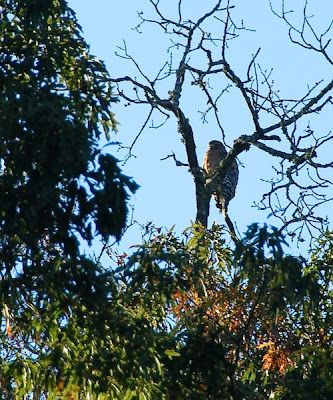
A watching hawk

Image
I've seen a hawk perched up high in a declining oak in the early morning for some time. The tree is below our big parking lot (at work), but gives him/her a great view of the meadows in the morning. It's one of our red-shouldered hawks - we have two pairs, I think, at the Garden where I work. Today I had my camera, so was able to 'see' a bit closer. A mockingbird was singing nearby. And persimmons were ripe and ready to eat.

Bee flies and syrphid flies

I was fortunate enough to be on a birding excursion this afternoon in a class that I've been taking. We saw all sorts of interesting things, thanks to our instructor, a great birder, but also an experienced entomologist. We saw birds, of course, and we're in the midst of peak spring migration , but I think my favorite new thing was learning about bee flies. They look like small, very cute bees, but are actually bee mimics. This one was visiting small pale tangerine-colored flowers out in the meadow (a weedy plant that I should know the name of, but which is really quite lovely). They're pollinators, just like bumblebees, honeybees, and other bees, but as flies, mimic bees to avoid predators. Here's a great array of bee fly images from giffbeaton.com. Similarly, watching a syrphid fly that mimics yellow jackets was fascinating. These flies are also flower visitors, and are sometimes called flower flies. Here are some good images from a NC Extension Sustainable Ag...

Observing hawks

Image
We first spotted the nest two weeks ago , and the red-shouldered hawk pair finished it about a week later. Now, the female is sitting on the nest, keeping a careful eye on passersby, and calling with her distinctive kerr-kerr sound. On the days I've been by, I've usually been able to catch a glimpse of her -- unfortunately, the nest is quite high up! I took a few pictures this morning with a long lens, but managed only to get a somewhat blurry shot in my minimal efforts. In poking around the web looking for information about their nesting and foraging behavior, I came across a great digiscope sequence of a nesting red-shouldered mom and offspring in California.

A late winter walk

Image
The calendar is late February, but there are many signs of spring on a morning walk at the Garden. All the winter and early flowering Asian species are in full swing; camellias, Japanese apricots, and magnolias, joined by the Mediterranean daffodils and rosemary. But some of our natives are also early; the tiny flowers of winged elm pose a nice contrast to the corky stems, and the male cones of red cedar ( Juniperus virginiana ) released great puffs of pollen when touched. Walking in the woodland wildflower area, part of the Garden's forest & woodland areas, we spotted first a single red-shouldered hawk in flight, stopping briefly so I noticed s/he was carrying a stick. The females are bigger than the males, but otherwise they look similar. Flying on to a large twiggy nest high in a tulip poplar tree, a second hawk joined the first, and then they stood on a nearby branch together. It's not too far from where a pair nested 2 years ago, and were quite easy to observe fee...