Posts

Showing posts with the label male ruby-throated hummingbird

First ruby-throated hummingbird

My gardening companion first spotted a male ruby-throated hummingbird on the feeder on Friday evening (April 1).  We saw him yesterday visiting the feeder, too.  Today, I saw him (I'm assuming it was the same bird) 'hawking' insects from a perch on the big Southern Red Oak near the house. It's hard not to think that somehow this is a fellow that remembers our feeder.  But he's probably taking a rest and fueling up for more traveling north.  (Hummingbirds often return the same site, but it's pretty early for that -- this is normally early male scout time). We have red buckeyes ( Aesculus pavia ) and coral honeysuckle ( Lonicera sempervirens ) in full flower now, so there's nectar available, too. I just saw a swallowtail (probably a black morph tiger swallowtail) visiting the Carolina Jessamine ( Gelsemium sempervirens ) out my study window.  Lots of Tiger Swallowtails are out now.

More hummingbirds

Image
There are at least three, maybe four, hummingbirds whizzing around the garden right now. They're all females, but they still fuss over the feeders and delight us with their chirps and buzzes. They'll probably be around a bit longer, and their brethren will be coming through until early October. Nectar is an important part of their diet, but equally important are the small insects they glean. The leaves of the old Southern red oaks near the house, which harbor lots of such insects, are a favorite foraging ground. Ruby-throated hummingbird and Campsis flowers Campsis radicans (featured in yesterday's post) is a particularly important source of nectar here in the Eastern U.S. Perfectly adapted to its primary pollinator, it depends on frequent visitation (by ruby-throated hummingbirds) for pollination and good seed set.

Hummingbird courtship

We've had a female hummingbird at our feeders and visiting Monarda and Lonicera flowers for some weeks. But eating lunch on the porch today, we were excited to see a pair of hummingbirds circle up and then down, and then disappear on the ground. Woo-hoo! Checking out All About Birds (Cornell Lab of Ornithology), Journey North , and Operation Ruby Throa t, it seems promising that this was the final courtship ritual prior to mating, so maybe we'll have a hummingbird nest & babies in the next few weeks. Here in the Southeast, we apparently can have double broods , so maybe our pair will be producing one of these!

Spring and a first hummingbird!

Image
It was a lovely day spent gardening. Today is Easter for Christians, and even though we're not religious, as a secular holiday, it has symbolism as a time of rebirth. Spring is here. A newly mown 'lawn', borders and meadow edited of winter annuals, a flourishing vegetable patch, and all's right in the garden. And now, about to have our dinner with greens and lettuces freshly harvested, looking out my study window, our first ruby-throated hummingbird of the season visited a few of the Carolina Jessamine flowers on the trellis out the window. Hooray!

A first hummingbird?

Image
I'm so jealous of my fellow butterfly (and wildlife) gardening enthusiasts and friends in Six Mile, SC. They've now seen two (!) male ruby-throated hummingbirds, one yesterday, and one today. I know from the migration maps on Journey North and Hummingbird.net that there have been sightings of first hummingbirds (through today) here in the eastern U.S. as far north as Delaware, Connecticut, and Massachusetts (and in the Central U.S as far as Michigan). But I haven't seen one yet. Hhmrrph. There are feeders waiting, not to mention coral honeysuckle in full bloom and Eastern columbines, but they'll come. And hopefully, one will attract a female to stick around.

Ready for hummingbirds

Image
It's still too early to expect the first male ruby-throated hummingbirds; they've made it up to central Georgia on the most recent map from Journey North, and north GA on hummingbird.net , but the colder weather this weekend will slow them down. Last year, hummingbird.net reported sightings on March 23 and 24 in our area -- probably the earliest scouts! The males come first, to scout out and claim their breeding sites, followed by the females a couple of weeks later. The males roughly follow an overnight temperature isothermal line in their migration, staying just about the freezing line, according to Operation RubyThroat , managed by Bill Hilton, an active hummingbird investigator and naturalist based at Hilton Pond, in York Co, SC. Our first sighting last year wasn't until April 13 , when we saw a single male. But I've got the feeders ready as of this afternoon. Here's a young female coming towards the porch feeder last summer.

Time to head south?

Image
The ruby-throated hummingbirds are whizzing around our 3 feeders -- there are at least 4-5; it's hard to tell. It's a reminder that fall is coming, even though there's plenty of warm weather ahead, the days are visibly shortening. A fellow garden blogger in northern B.C. reports a first frost warning (yikes!); another garden blogger friend in England is putting one of his pea patches to bed, and sowing mustards as a cover crop. And I'm seeing monarchs coming through as they make their way south to Mexico, and their overwintering grounds in Michoacan.

Birds at the feeders

Image
A goldfinch on the thistle feeder caught my eye from the study window. When I went outside, I heard a woodpecker up in the oak tree, and saw him finally. Then, he dropped down to get some suet. Then, looking back towards the feeders, I saw a male hummingbird, getting a long couple of swallows, then the male goldfinch back on the thistle feeder. Shortly after that, a female goldfinch came to the feeder, followed by another male. Then, they all flew off. It was a lovely way to spend a few minutes in the garden.

A hummingbird's territory

Image
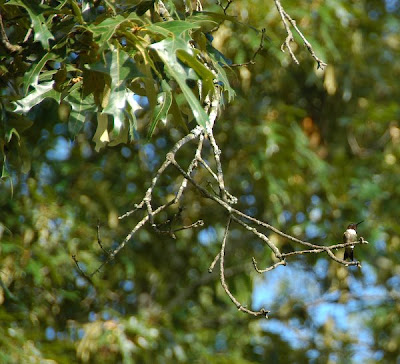
The old Southern red oak near the house has a number of bare branches, twigs really, that have been favorite perching places for ruby-throated hummingbirds over the years. There are two feeders nearby, as well as flowers to visit, and this particular branch is perfect as a foraging perch, apparently. It's also easy for us to notice them sitting there. This morning, I saw a pair of brown thrashers courting, while I was checking things in the garden, and thought I'd change lenses to get a better image. Of course, only one thrasher was visible preening up in one of the hemlocks by the time I returned, but I was able to take a few shots of 'our' male hummingbird, waiting for insects and monitoring his territory. Hopefully, he has a mate somewhere nearby.