Posts

Showing posts with the label drought

Rain is welcome

Image
A rainy weekend in March is always welcome.  We rely on spring rains (of whatever sort) to get us through droughty periods in early and mid-summer.  Thankfully, this rain comes after a much warmer than normal spell, and helps rehydrate soils. Clemson is the red dot! This front was wide and brought rain almost all day, close to an inch, I think, judging by the pot saucer near the mudroom door.  And more rain is expected overnight and tomorrow. We're still facing abnormally dry conditions, moving towards drought.  The arrow marks roughly where we are in the Piedmont of South Carolina.

Droughty conditions and watering again

Image
We don't like to water much;  we've designed our landscapes (yikes, it's now plural) to be largely self-reliant on rainfall, but a very long spell (weeks and weeks, maybe a month or more without any rain), and pushing 90°F temperatures through the end of September has even hardy natives looking wan, not to mention those from moister sites and higher elevations. So I'm dragging the hose around, my gardening companion has gone to the mountains this weekend to water newly planted trees and shrubs in our landscape there  (he also has vegetable harvesting duties, and watering the raised beds, too).   So, we're hoping for some decent rain with the cold front that's coming in tomorrow. In the meantime, I've managed to tidy up the perennial beds, get them ready for needed renovation, change out some containers, and plant to edit the front meadow tomorrow morning (it needs it, big time). There's a group of folks coming after a Osher Lifelong Learning Gardening fo...

Fall equinox

I'm doing a Harvest Moon walk tomorrow evening, which should be nice.  And, it's always good to celebrate the first day of fall. It's warm enough still (too warm, actually) that the nocturnal symphony (crickets, cicadas, tree frogs, and their ilk)  is still in full swing, although muted by droughty weather. And, we need rain.  Planting (of shrubs, perennials or fall vegetables) requires lots of watering to properly get a planting place ready.  Even in the mountains, I've had to frequently drench my raised beds to keep up moisture levels.

Recharging aquifers

It's been raining all weekend -- lots. This is a good thing, since even though our reservoirs (for drinking water and power generation) have been full since early last fall, recharging aquifers takes a lot more moisture, especially following the profound drought of the last decade (more or less). Hopefully, these winter rains will fully recharge groundwater supplies. My gardening companion conveyed a colleague's report from winter break of low aquifers in Florida, depleted of much groundwater to attempt to save citrus crops from freezing (by applying a coat of protective ice). Concerns about sinkholes rerouted traffic, and folks who had dry wells were compensated. The abundant rain this winter is good for native landscapes as well as our gardens. But, it was a good weekend to stay inside.

The benefits of rain

After several years of drought (quite severe), it's been a relief (a joy, really) to be able to be away for a few days without coming home to drought-stressed plants (vegetables and containers, window boxes, and hanging baskets). It's early in the growing season, to be sure, and we've got LOTS of hot weather ahead, so I'm still working with an array of drought tolerant species in my containers. But I do hope that we'll have a respite from the unrelenting drought of the last decade or so, minus a year or two!

A deepening drought

Image
My gardening companion wanted to walk along the lakeshore yesterday morning; I found it bittersweet. Our nearby lake (Lake Hartwell) is SO low that it's looking entirely different that we've ever seen it. The eroded sandy edges below the rocky clay now gives way to silt and then to water. We watched a Great Blue Heron enjoying a fish, with a Belted Kingfisher nearby.

Finally a prospect of some decent rain

Image
Gardeners and naturalists are almost as keen as farmers following the weather. Where I live, garden, and pay attention to the natural world, we're in the center of quite a severe drought. We normally get fairly even rain throughout the year, but not for the past ten years or so, except for one year (the year the front meadow looked especially fabulous, with moisture-loving Joe-Pye weed and huge Blazing Stars ( Liatris spp.) And the last two summers have been truly exceptional (note the current rating for the dark red area- ugh). I've marked where I live with the arrow! But Tropical Storm Fay is bringing some decent rain, even to us in Upstate South Carolina. I'm sorry for the flooding in Florida, but we'll be thankful for the downpours that are predicted for the next few days.

Finally a thunderstorm...

Image
It's hard to overstate our drought here. We haven't had more than a small amount of rain since mid-May (1/2 inch, tops, in our garden), and normal rainfall is about ~4 inches a month. We're 10 inches behind for this calendar year, and over 20 inches behind, for the last year & a half or so. So, it's cause for excitement when a potential thunderstorm actually materializes (this is a normal occurrence in 'regular' years). Summer thunderstorms are very spotty in their distribution and rainfall amount. We just had over 1/2 inch in about 20 minutes. What a relief to have something. And the clouds are dark with lots of thunderstorm possibilities predicted for tonight and the rest of the week. Any bit helps plants, animals, and insects parched from lack of rain. I've just see the male hummingbird check out the vines (for insects?) near the window twice on his 'trapline' around the feeders, even in the rain.

A new infusion of seeds

Image
I just received more seeds (hooray!) -- I love getting seeds for new things, and this shipment includes kohlrabi (Dyna Bio), something called Ruby Streaks mustard, French Sorrel, Giant Winter Spinach (hope springs eternal here in our acidic soils), and parsnips (Cobham Improved Marrow). I've tried growing parsnips before (last year in an equally droughty summer), so this may not be the year to try again. The drought doesn't get much worse than what we currently have. There are many places that get a lot less rain than we do, normally, so I hate to whine, but the U.S. Drought Monitor place shows the area where we live as one of the worst areas in the country. Look down to the Southeastern U.S., where the big red patch is; we live there.

Too much dry weather

While the Midwest is suffering the consequences of too much rain, again, we haven't had any significant rainfall in weeks (I should say weeks and weeks). In the last six weeks, we've maybe had 3/4 to an inch of rain where we live in Upstate South Carolina, way less than 'normal.' The natural areas up in the mountains look stressed, for lack of normal summer rain, which often is afternoon thundershowers. We don't live in a Mediterranean climate, normally, but maybe we need to garden like we do. Even some of my drought tolerant herbs are drooping from lack of moisture. I can still water, since we're not under a watering ban, but the local lakes/reservoirs are lower around the edges than we've ever seen them, in the 15-odd years we've lived here. Someone mentioned to me recently that 'they' -- that is, the Drought Emergency team for South Carolina -- didn't want to alarm people -- uh, hello-- we're in a significant drought, and why aren...

A warm spring day

Image
It was close to 80°F (~27° C), pretty warm for late April. We've had, what seems to me, more windy days than usual for spring, but maybe I'm mis-remembering. What it does mean, with low humidity, warmth, and windy conditions, is that it's seeming pretty dry again. The first graders in our garden program rotations this morning were wilting by the second program; they were hot, thirsty, hungry, and tired. We're not used to warmth quite this early, even in the Southeastern US. I was hopeful in February and March (and the official drought projections had improved), that maybe we'd spring back into something more like "normal" rainfall, and maybe we still will. But I needed to water the vegetable garden this evening, even the sturdy garlic, shallot, onion, and potato beds, since it hasn't rained much for a couple of weeks (but for about a 1/4 inch last weekend). My deep-rooted 'Italian dandelion' is perfectly happy, however, as is the equally dee...

Rain

We need all the rain we can get in the Southeast. It's been raining tonight, and this winter, more in some places than others. The Greenville paper reports that we're still behind by a third of normal for this year for the area that they monitor. The local ponds have filled up but the larger lakes (which serve as local water reservoirs, in addition to their recreational uses, and power plant support) have tremendously large blank areas along their edges. The long-term forecast from NOAA suggests that the drought will ease here this spring. I hope so. But I'm also hoping that the winter respite from the evaporative stress of summer and fall won't lull us into thinking the drought is over. I heard a public service message last week (on a Charlotte, NC station) with the Governor of North Carolina reminding listeners to conserve water, as the drought was still severe.

Drought, woodpeckers, bats, and rocks

It hasn't been a week for gardening -- we finally got some rain (half an inch last Friday) and almost 7/10 of an inch yesterday. In the drought we're in, counting every drop is important. We're worrying about the long-term forecast; my colleague sent an e-mail about hearing that the National Weather Service has projected drought through next summer. It's cool now, but any soil recharge we get is great. Here in SC, we're (at least as a public garden) thinking about whether we can water next summer -- I'm expecting that we'll have mandatory restrictions like our neighboring states of Georgia and North Carolina. What's been fun, however, is the parade of birds through our home garden. They're definitely enjoying the water I put in the birdbath and large dishes on the ground. In recent school programs at the botanical garden where I work, I've enjoyed pointing out woodpeckers, bat boxes (we have bats that roost in the trees, and use the boxes a...

Drought and Waterwise Gardening

We had an inch of rain this week, thank goodness, since we hadn't had anything since mid-September, but I'm continuing to notice what plants are doing well in this droughty fall, following a brutally hot and dry August. I attended a waterwise gardening symposium in Athens at the State Botanical Garden of Georgia recently, and the depths and extent of the drought we're in here in the Southeast became ever more evident. I'm certainly rethinking my approach to the challenge; I don't think my fellow participant is on the right track, when she pointed to an aloe plant on the lunch table, and said, "this is what we need to grow," nor that Mediterranean-style gardening or High Desert gardening is the answer either, but we do have a whole range of exceptional native plants with deep roots that are able to withstand long periods of drought in summer. Mix in a few of those Mediterranean plants and high desert plants that can tolerate our heat and humidity in summer,...

Sowing more seeds

Image
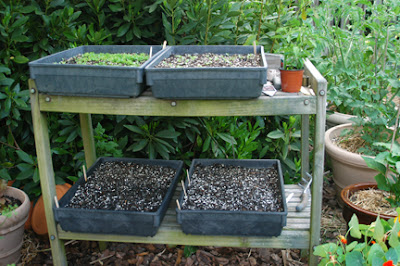
It's been a tough summer in the vegetable garden. The late freeze in April, the drought and heat for most of the summer, and now really low soil moisture levels combined with higher soil temperatures, make it hard to coax along even the fall greens. Seedling in the flats are coming along OK, but the seeds sown directly in the garden are taking their time. I haven't been optimistic enough to plant anything in the satellite garden, as I think the thirsty woodchucks will appear out of nowhere to devour any young kale, chard, or lettuce plants that manage to germinate. But we've just had a lovely downpour for quite awhile, thanks to some left-over moisture from the hurricane in the Gulf, and hopefully got at least 1 1/2 inches, maybe two. This would be excellent for recharging the soil layers farther down. I'll sow another set of seeds of greens and lettuce tomorrow, I think....

Waterwise gardening

Image
In this summer of extreme heat, and severe drought here in South Carolina, it's hard NOT to think about drought-tolerant plants. We have tried to establish a low-water use landscape, but that doesn't mean no water, especially with recently planted perennials, shrubs, and trees. We've both gotten really tired of dragging the hoses around to water these young plants that we don't want to lose, but anything planted this year needs water to survive the high temperatures, hardly any rain, and too much wind conditions that we've had. Our plants would normally thrive, after establishment, on normal rainfall, but rainfall this summer has been anything but normal, and even the toughest drought-tolerant perennials have wilted in the late afternoon sun. Trees, with their much more extensive root systems, and shrubs haven't been much affected, and certainly reflect their higher drought-tolerance. Conditions this summer have me thinking about waterwise gardening (a 'n...

Hoping for rain again

Image
We were lucky at the end of August -- lots of folks around us didn't get the welcome relief of the heavy thunderstorms that added over 2 inches of rain to our garden. The state drought response team has just raised drought levels to severe in SC - here in the Upstate (roughly the expanse in SC between Atlanta and Charlotte, NC), it's particularly bad. Our garden is a low-water use garden (except for the pampered vegetables and the much less pampered container plants), although they do make do with hand-watering and don't have soaker hoses that run for hours on them. A neighboring county is calling for water conservation, and only watering lawns (!) before 5 am. In my opinion, it's a bit much to water lawns at all, but we're not lawn people. We have brown patches that have developed in our Zoysia lawn areas. But we're still monitoring plants that have been planted in the last few years, and watering them regularly. Anything that's been planted in the la...