Posts

Showing posts with the label gardening with natives

A luminous meadow

Image
I spent some time this afternoon cleaning up and 'editing' the front meadow.  It needed to be freed of the weedy annuals that had popped up in late summer, the remnants of vines that had clambered around (including the passionvine, Passiflora incarnata ), and generally tidied up -- the Helianthus hirsutus (Rough-stemmed Sunflower) was downright ugly, even to a wildlife-friendly gardener, and I'm confident the goldfinches have long since eaten its seeds.  And the Common Milkweed ( Asclepias syriaca ), which is such a great host for monarch caterpillars, is in decline as well, and most monarchs are well south at this point, too, and any stragglers are not going to be successful in reproducing here, before the first frost. Front meadow in evening It was satisfying work, even if driven by thinking I might have the Osher Lifelong Learning class come visit next after the Gardening for Nature class that I like doing for them.  I think I'll describe what our next projects are...

Gardens, traveling, and challenges

Image
Heading off to attend the Garden Writers Association annual conference in Dallas, I took a pre-conference detour to Austin, Texas, where I grew up.  Austin is a great city, but not the place that I remember.   My mom's house (our family home) was in Northwest Austin, but my dad (and his wife) and my sister (and her husband) now live well outside of anything that I'd call 'in Austin' today, outside the Highway 360 loop. Lobelia cardinalis along Hill Country Stream I mention this in talks; where I rambled as a young teenager, poking around in natural landscapes, is now completely developed.  From where our family home was, once open space, is filled with houses to where my sister lives, a considerable distance away. But, I was encouraged by the sense of place that many residential and commercial landscapes had.  Central Texas sees the convergence of the Edwards Plateau,  black land prairie and other ecosystems.  It makes a great mix, both for vegetation ...

Planting native perennials

The Botanical Gardens of Asheville Spring Plant Sale and the WNC Herb Festival were full of cool plants this weekend. We snagged all sorts of interesting natives, from Wild Quinine ( Parthenium integrifolium ), Goldenseal, American Ginseng, and ramps, along with Golden ragwort ( Senecio aureus ), Anise-scented Goldenrod ( Solidago odora ), Wild Yam, a Gaillardia cultivar, (Rough Blazing Star) Liatris aspera , and a lovely Carex spp. Added to the Penstemons , Coreopsis , Centaurea , and Achillea that came as trial complimentary plants from Blooms of Bressingham (I'd signed up for them at the Garden Writer's Association annual conference), we had lots to plant in the front perennial bed at our small mountain house!

Why shouldn't more parking lots look like this?

Image
I'm weary of looking at uninteresting planting in parking lots (and elsewhere) that do nothing for the natural world. Why not include a diversity of shrubs and trees? Why not include grasses and perennials? Why not include rain gardens that help filter runoff and provide mini-wetlands that might support a few dragonflies? I've bumbled across a few good examples lately. The photos above, of parking lot for a Portland bakery/coffee house were nice. And the urban parking near UNC Asheville and the Botanical Garden of Asheville, planted in natives, gets my kudos for providing a sense of place.

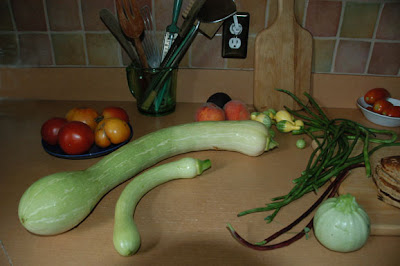
A giant tromboncino squash!

Image
This big one was hiding near a old tree stump. (I normally harvest them at the size of the one next to it). Notice its size relative to the cutting board. Yikes! Oops, one that got away! Amazingly, it was still quite edible, roasted in slices with garlic and olive oil. The yard-long bean vines in the satellite garden are starting to produce -- need to knock off some aphids (their one pest) with some water. And, all of our tomatoes love the heat and dry weather that we've had, as long as we water. It's hard to imagine all the rain that folks up in the northeastern U.S. and Midwest have experienced this summer.

A front entrance to the garden

Image
Our front yard didn't always look this way. When we moved in, it was a long dull expanse of lawn, punctuated by a row of magnolias and dogwoods, in alternation with a single white pine. Beyond that was a dying red tip hedge, planted by the second owner (we're the third owners). We've lived here almost fifteen years now, but it didn't take long for the young trees that my gardening companion planted to make a difference. Now, it's like a natural woodland, with a variety of native hardwoods developing the canopy, with an understory of small native trees and shrubs. All that we did was try to recreate (and speed up) what nature might do in a open field, if there were ample seed sources nearby. We had to provide our own saplings; but the regenerative power of planting is as simple as digging a hole, amending the soil a bit, and keeping a young tree or shrub watered through its first seasons (and maybe a bit during exceptional droughty times like now.) An nice comment ...

Learning more about native plants

Adding native plants to your garden sometimes feels a bit serendipitous. Commonly used natives may be widely available in nurseries, but many are little known as garden plants, and so much harder to find. It's also important (just as it is with all plants) to choose the right plant for the right place. So, selecting natives of your region, or that those that are adapted to it, are the ones to try. Some natives are fussy, and not easy to grow, but many, when planted in appropriate sites, are relatively pest-and problem-free, being adapted to the regional environment. One of the first steps to adding natives is to learn more about what’s available and what’s recommended for landscape use. Some species that are hard to propagate or that are slow-growing, or don’t take well to containers may be impossible to find; similarly, herbaceous species with a limited market are the venue of specialty mail-order nurseries. Here are some of my favorite references about using native plants in ...